A new generation
of ATIS broadcast
device.
The SBX2 was designed for the networks and workstations of its era, and it has served airfields well for a long time. The SBX3 is being built for the ones they actually run now — and for the security review every new install has to pass.
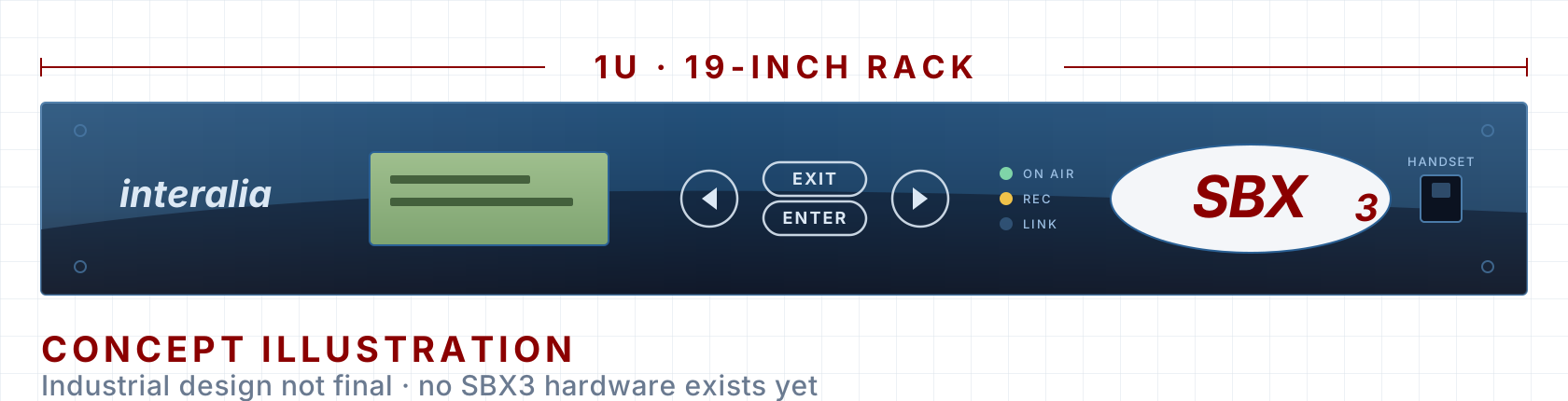
Four things changed underneath the product.
None of them are the SBX2's fault. All four of them are reasons an airfield specifying equipment today asks questions the SBX2 was never designed to answer.
The parts are going away
Silicon designed into the SBX2 generation is end-of-life. A platform meant to serve twenty more years needs components that will still be sourceable in twenty years.
The airfield moved to IP
Telephony around the ATIS is increasingly SIP. Analog still matters for the transmitter feed, but it can no longer be the only way in.
Nobody wants to install a Windows client
XMUCOM+ does its job, but it needs a managed workstation, a sound card and an IT exception. A browser does not.
Security review is now part of procurement
Networked equipment on the field gets assessed before it gets bought. That has to be designed in from the first schematic, not bolted on at the end.
SBX2 today, SBX3 as designed.
Everything in the right-hand column is a design target, not a shipped specification. It will change as the build progresses, and this page changes with it.
SBX2 ATIS
SBX3 ATIS
No launch date is being announced.
We would rather tell you which phase the work is in than promise a quarter and move it. This strip updates as each phase closes.
Requirements
What the next platform has to do, written down and reviewed.
Design
Hardware and software architecture with our engineering partner.
Prototype
First hardware on the bench and on the air in our own lab.
Field trials
Pilot sites running it beside their existing ATIS. This is what the list is for.
Certification & release
Compliance testing, then general availability.
We would rather design it with you than surprise you at launch.
Early specifications, migration guidance from XMU+ and SBX2, and the call for pilot sites all go to this list first. If you operate or resell Interalia ATIS, this is the shortest path to influencing what gets built.
Specification updates only. No newsletter, and we do not pass your address on.
Get the SBX3 briefings
Send us a short note with your name, organization and role, and we will add you to the list. If you would consider being a field-trial site, say so in your message.
Keep me posted on the SBX3The four we are asked most.
If yours is not here, ask it — the answer usually ends up on this page.
Does my SBX2 stop being supported?
No. We still support XMU+ hardware from decades ago; the SBX2 is not going anywhere. The SBX3 is what you buy when you replace, not a deadline to replace by.
When can I buy one?
There is no announced date, and we are not going to invent one. The phase strip above is the honest answer, and the list hears first when that changes.
Will my recordings and configuration carry over?
Migration from XMU+ and SBX2 is an explicit design requirement. The detail is being worked out now, and migration guidance goes to the list as it is settled.
Can my site be a field trial?
Quite possibly. Tick the box on the form above and tell us about the field — we are looking for a spread of sizes, languages and network situations, not just easy ones.
Announcement and messaging hardware, designed and built in Canada since 1975.
Vernon, BC V1H 2K54786 1st Ave South, Suite 102
Seattle, WA 981341-800-661-9406